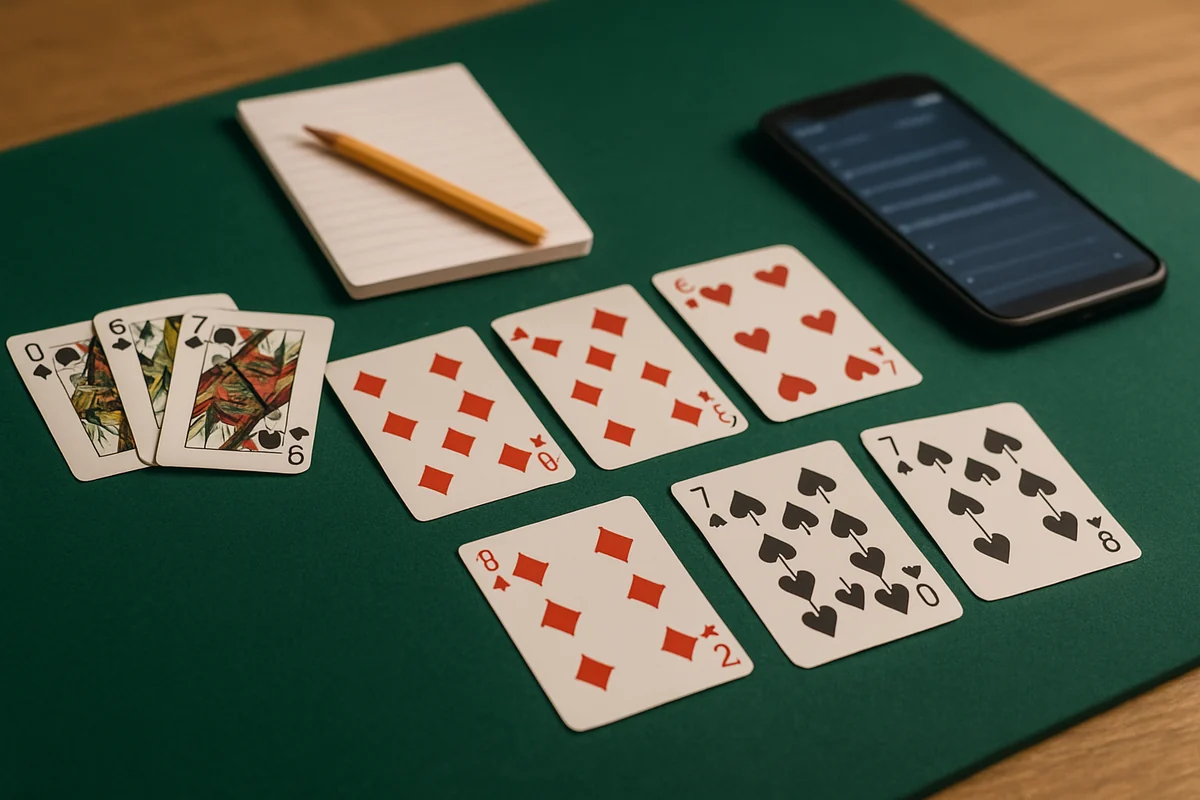
Discover the basics of Rami 51: why you often need to reach 51 points to play, how to build your combinations, and how to count points at the end of the round.
Rami 51: The Rules to Know
Rami 51 is a popular variant of the Rami game, often played in French-speaking circles. This game is based on a fundamental rule: reaching a minimum of 51 points to be able to play your cards. In this article, we will explore the basics of Rami 51, possible combinations, the calculation of points at the end of the round, as well as family variations that may exist.
In Brief: Why Do We Talk About Rami 51?
The term "Rami 51" refers to the necessity of reaching a minimum score of 51 points before being able to play your cards on the table. This rule is often adopted in many player groups, but it is important to note that conventions can vary from family to family. Thus, some players may choose to apply a different threshold based on their playing habits.
The goal of the game is to form combinations of cards, such as sequences or groups, in order to get rid of all your cards. The round ends when a player successfully plays all their cards, which can lead to variations in the final score depending on the remaining cards in hand.
The Principle of Minimum to Play
To play their cards in Rami 51, a player often needs to reach or exceed 51 points. This threshold is determined by the value of the cards that make up the combinations. For example, numbered cards from 2 to 10 are worth their face value, while face cards (Jack, Queen, King) are worth 10 points each, and the Ace can be worth 1 or 11 points depending on the adopted convention.
It is therefore essential to know the value of the cards well to plan your plays. Players often need to evaluate their hands and decide which cards to play based on their value and the possibility of forming combinations that reach the required threshold.
Sequences, Combinations, and End of Round
In Rami 51, players can form sequences or groups. A sequence consists of consecutive cards of the same color, while a group consists of cards of the same value but of different colors. For example, a sequence could be 4-5-6 of hearts, while a group could be three 7s of different colors.
To illustrate, let's take an example of a combination reaching 51 points. A player could play a sequence of 7-8-9 of clubs (27 points) and a group of three 10s (30 points). This would give a total of 57 points, allowing the player to play their cards.
How to Count Points in Rami 51
The calculation of points at the end of the round is a crucial step in Rami 51. Points are counted based on the remaining cards in the hands of players who have not managed to play all their cards. Numbered cards from 2 to 10 are worth their face value, while face cards are worth 10 points and the Ace can be worth 1 or 11 points, depending on the convention.
For a simple example, if a player still has a 3, a 5, and a King in hand at the end of the round, they will count 3 + 5 + 10 = 18 points. These points will be added to the scores of other players who have managed to play all their cards, which can influence the final outcome of the game.
Family Variations to Clarify
There are many variations of Rami 51 that can modify the basic rules. For example, some families may choose to play with a different target score or assign different values to cards, such as the Ace or Joker. Other variations may include penalties for players who fail to play their cards.
It is therefore advisable for players to clarify the rules before starting a game to avoid any confusion. RamiPlus allows users to record their own game convention, making it easier to manage different variations.
Track a Game of Rami 51 with RamiPlus
RamiPlus is an application designed to help players track their games of Rami 51. It allows you to keep a history of scores, manage rounds, and record game conventions. With RamiPlus, players can focus on the game without worrying about score calculations.
By using RamiPlus, you can easily track your performance over games and adjust your strategies based on the results. This can also be a great way to share your results with friends or family.
Useful Card Value Table
| Card | Value |
|---|---|
| 2 to 10 | Face value |
| Jack | 10 points |
| Queen | 10 points |
| King | 10 points |
| Ace | 1 or 11 points (depending on the convention) |
Common Mistakes
Here are some common mistakes players may make in Rami 51, along with tips to avoid them:
- Not knowing the value of the cards: Make sure you understand the value of each card before you start playing.
- Forgetting to check the conventions: Before playing, discuss the rules with other players to avoid misunderstandings.
- Not counting points correctly: Take the time to accurately calculate points at the end of each round to avoid score errors.
- Playing without reaching the minimum: Remember that it is often necessary to reach 51 points before playing, check your combinations before playing.
FAQ
Why do we need to reach 51 points to play?
Reaching 51 points is a rule often adopted in Rami 51, which aims to balance the game and encourage players to form stronger combinations before playing.
How can we calculate points at the end of the round?
Points are calculated by adding the value of the remaining cards in the hands of players who have not managed to play all their cards.
What are the common variations of Rami 51?
Variations may include modifications to card values, penalties for players who do not play, or different target scores depending on the groups.
How can RamiPlus help me play Rami 51?
RamiPlus allows you to track scores, manage rounds, and record game conventions, thus facilitating the gaming experience.
Can we play Rami 51 online?
RamiPlus is an application that allows you to play Rami 51 online, tracking scores and personalized rules.
To start a game of Rami 51 and track your scores effectively, feel free to visit RamiPlus.